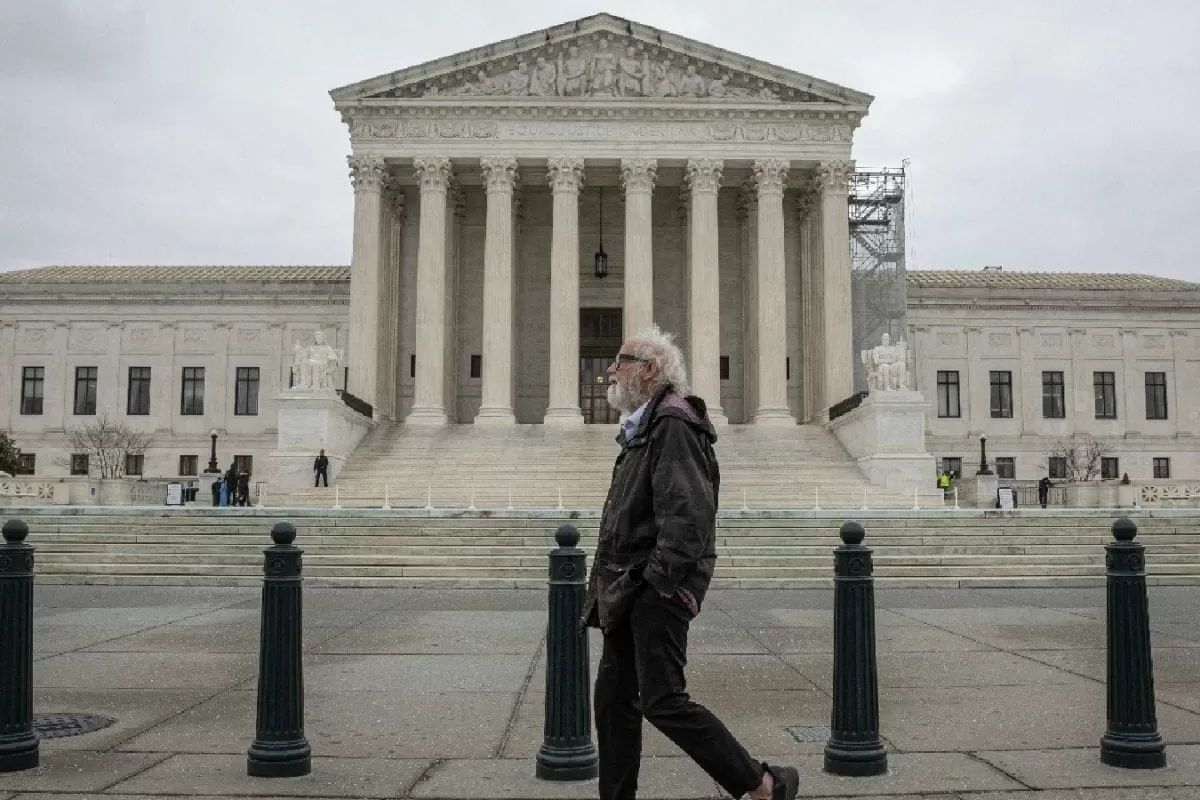
In a recent decision, the US Supreme Court has allowed the Trump administration to stop US passport applicants from designating the sex reflecting their gender identities on the document. This decision has sparked controversy and raised concerns among the LGBTQ+ community. However, the Supreme Court’s decision must be viewed in the context of the law and the Constitution, and not just through a political lens.
The case in question involves two transgender individuals, Dana Zzyym and Mario Lopez, who were denied passports by the State Department because their gender did not match the sex listed on their birth certificates. Zzyym, who identifies as non-binary, and Lopez, who identifies as male, argued that the State Department’s policy violated their constitutional rights and discriminated against them based on their gender identity. The case made its way to the Supreme Court, where the justices ruled in favor of the Trump administration’s policy.
The Court’s decision was based on a technicality, with the majority opinion stating that the challengers did not have standing to sue the government because they had not exhausted all administrative remedies. This means that Zzyym and Lopez could have appealed the State Department’s decision and pursued other avenues before bringing the case to the Supreme Court. The Court’s decision does not address the constitutionality of the policy itself, leaving the door open for future challenges.
While some may view this decision as a setback for the LGBTQ+ community, it is important to note that the Supreme Court’s role is to interpret the law, not to make policy decisions. The Court’s decision does not condone discrimination against transgender individuals, but rather reinforces the principle of separation of powers and the importance of following proper legal procedures. It is also worth noting that the Supreme Court has previously ruled in favor of LGBTQ+ rights, including the landmark decision legalizing same-sex marriage in 2015.
The Trump administration’s policy on gender designation in passports is not a new one. In 2010, the State Department issued a policy that required an individual to have undergone gender reassignment surgery in order to change the sex listed on their passport. This policy was changed in 2016 under the Obama administration, allowing individuals to change their gender designation without requiring surgery. However, in 2018, the Trump administration reversed this policy, reverting back to the 2010 guidelines.
The State Department’s policy on gender designation in passports is based on the principle of “biological sex,” which refers to the sex listed on an individual’s birth certificate. This policy is in line with international standards and is used to ensure consistency and accuracy in travel documents. While this may be seen as restrictive by some, it is important to note that passports are used for identification purposes and must accurately reflect an individual’s legal identity.
It is also worth mentioning that the State Department does provide an option for individuals to obtain a limited-validity passport, which allows for the use of a gender-neutral “X” marker for those who do not identify as male or female. This option was implemented in response to the growing number of individuals who identify as non-binary or gender non-conforming. While this may not be a perfect solution, it shows that the government is taking steps to accommodate the needs of the LGBTQ+ community.
In conclusion, the US Supreme Court’s decision to allow the Trump administration’s policy on gender designation in passports must be viewed through a legal lens. The Court’s role is to interpret the law, and in this case, the challengers did not follow proper legal procedures. This decision does not condone discrimination against transgender individuals, and the door is still open for future challenges. It is important to continue the conversation and work towards finding solutions that respect the rights of all individuals, regardless of their gender identity.