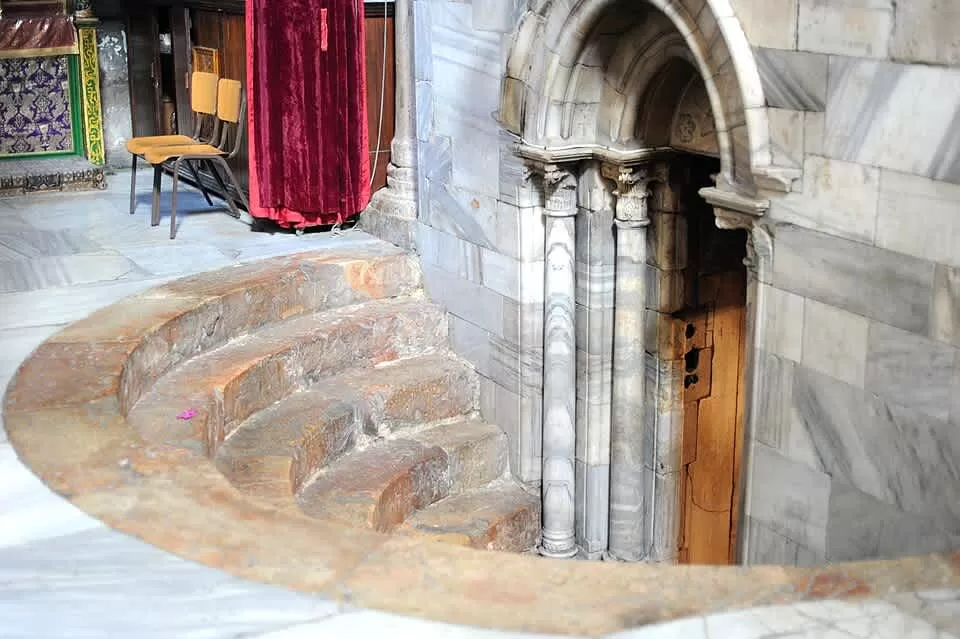
The restoration work for the “hallowed site” in Palestine has been making headlines this week, following a decree from the Presidency of the State of Palestine. This significant development has been welcomed by the Catholic community and is seen as a step towards preserving the rich religious and cultural heritage of the region.
The “hallowed site” in question is the Church of the Nativity in Bethlehem, which is believed to be the birthplace of Jesus Christ. This holy site holds great significance for Christians around the world and is a popular pilgrimage destination. However, due to years of neglect and damage, the church was in dire need of restoration.
The restoration work was initiated by the Palestinian Authority, in collaboration with the Palestinian Ministry of Tourism and Antiquities, and the Palestinian Christian community. The project is being carried out by a team of experts from the Palestinian Ministry of Tourism and Antiquities, with the support of the United Nations Educational, Scientific and Cultural Organization (UNESCO).
The restoration work includes the repair and reinforcement of the church’s roof, walls, and floors, as well as the restoration of the mosaics and frescoes that adorn the interior of the church. The project also aims to improve the overall infrastructure of the church, including the installation of a new lighting system and the renovation of the church’s plumbing and electrical systems.
The decision to restore the Church of the Nativity was made after a thorough assessment of the church’s condition, which revealed that it was in urgent need of repair. The restoration work is being carried out with great care and attention to detail, in order to preserve the historical and religious significance of the church.
The restoration work has been welcomed by the Catholic community, who see it as a positive step towards preserving the rich religious and cultural heritage of the region. Monsignor Maroun Lahham, the Latin Patriarchal Vicar for Jordan, expressed his gratitude for the restoration work, stating that it is a “great gift” to the Christian community and a testament to the strong relationship between the Palestinian Authority and the Catholic Church.
The restoration work is also seen as a symbol of unity and cooperation between different religious communities in Palestine. The Church of the Nativity is not only a holy site for Christians but also holds significance for Muslims and Jews. The restoration work is a testament to the shared history and heritage of these communities and their commitment to preserving it for future generations.
The restoration work for the Church of the Nativity is just one example of the efforts being made by the Palestinian Authority to preserve and protect the cultural and religious heritage of the region. In recent years, the Palestinian Authority has taken several initiatives to restore and maintain historical sites, including the restoration of the Church of the Holy Sepulchre in Jerusalem and the Church of the Nativity in Bethlehem.
The restoration work for the “hallowed site” in Palestine is a significant development that has been welcomed by the Catholic community and is a testament to the strong relationship between the Palestinian Authority and the Catholic Church. It is a reminder of the importance of preserving our shared cultural and religious heritage and the power of unity and cooperation in achieving this goal.
In conclusion, the restoration work for the Church of the Nativity is a positive step towards preserving the rich religious and cultural heritage of the region. It is a testament to the strong relationship between the Palestinian Authority and the Catholic Church and a symbol of unity and cooperation between different religious communities. Let us hope that this restoration work will inspire others to take similar initiatives in preserving our shared heritage for future generations.